Best Ice Cream Makers Guide
The Guide · Ice Cream Makers for Home Kitchens

The 20-minute ice cream maker needs a day’s notice.

Cuisinart says its 2-quart ICE-30 reaches soft-serve texture in as little as 25 minutes. The same listing asks you to freeze the bowl for about 24 hours first, and a frozen bowl churns one batch before it needs another day in the freezer. A Creami-style machine also works in minutes, on a base you froze solid in advance. Only the self-chilling machines, most of them built around a compressor, take a liquid base to ice cream tonight with no planning — and their makers quote anywhere from about 20 minutes to a full hour to do it. Churn time is the number on the box; how far ahead you have to think is the number you live with. What separates these machines is where the cold comes from, what a batch actually yields, the texture each mechanism produces, and where the machine lives between batches. We compared published specifications and current Amazon prices for 39 ice cream maker listings sold in the US.

By Ilane Tall6 picks · 39 ice cream makers comparedResearch-based — no testing lab, no invented scores

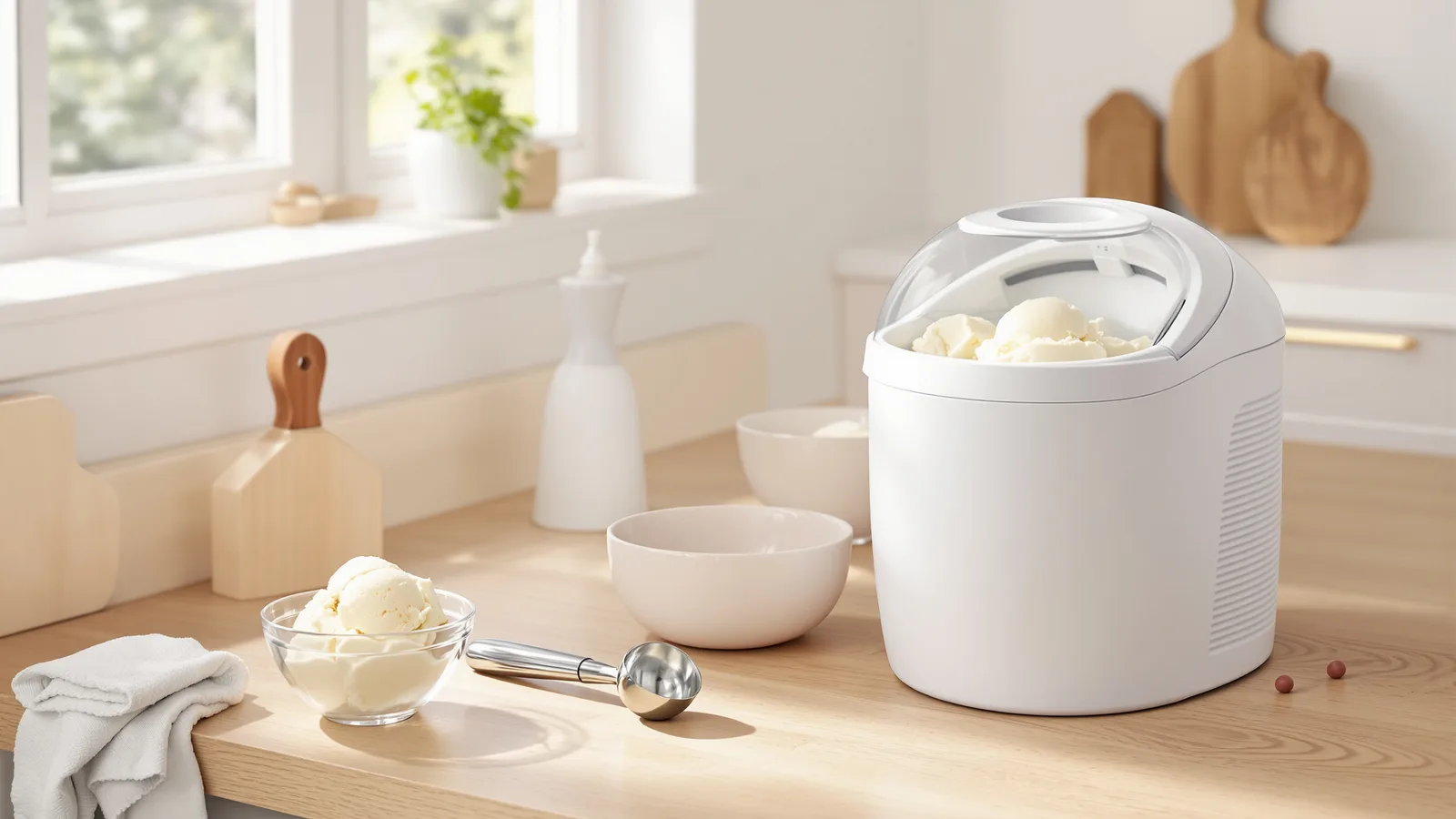
White countertop ice cream maker with a clear domed lid churning thick vanilla ice cream in a frosted canister, beside a steel scoop and two glass bowls of ice cream on a pale oak counter
The one to buy

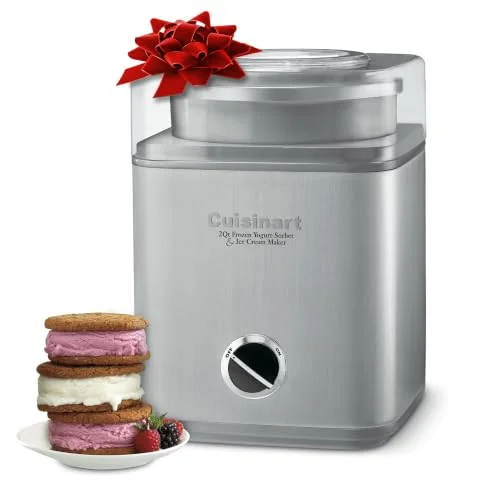
Cuisinart ICE-30 2-Quart Ice Cream Maker

The ICE-30 is the simplest way to make a family-size batch of churned ice cream, and it sits firmly in the budget tier. Its double-insulated bowl holds a full two quarts — enough, in Cuisinart’s words, for seconds and leftovers — and a heavy-duty motor does the churning. It makes ice cream, frozen yogurt, sorbet and frozen drinks, and the large ingredient spout stays open, so mix-ins go in during the last five minutes without stopping the batch.

Why a freezer bowl when compressor machines exist? Because in most homes ice cream is a planned dessert, not an impulse, and a freezer bowl is the least complicated way to make it: no refrigeration unit, nothing to vent, little to go wrong. Freeze the bowl, chill the base, churn, then give the ice cream a few hours in the freezer if you want it firm enough to scoop.

The honest caveat: the bowl is the whole cooling system, and Cuisinart says it needs about 24 hours in the freezer to freeze completely. One frozen bowl makes one batch; a second batch the same day needs a second frozen bowl. The listing gives no bowl dimensions, so clear a freezer spot before you order. If spur-of-the-moment ice cream matters more than budget, look at the compressor machines below.

2-quart freezer bowl·Pre-freeze about 24 hours·Heavy-duty motor·Open spout for mix-ins
Cuisinart ICE-30BCP1 2-quart freezer-bowl ice cream maker in silver
Price
$59.95
Check price on Amazon →

Prices change. We refresh them, but Amazon is the authority.

Before you buy

Four things decide this purchase. The churn time is not one of them.

Where the cold comes from

There are three answers, and each decides how far ahead you plan. A freezer bowl holds coolant sealed between double walls: freeze it for about a day, churn one batch, freeze it again. A compressor machine is a small refrigeration unit with a churn on top; it chills as it stirs, so a second batch can follow the first. A Creami-style processor freezes nothing: you freeze the base in its tub — H-Duka specifies 24 hours — and the machine shaves it smooth with a spinning blade.

Bowl size is not batch size

Read the capacity line twice. Elite Gourmet sells a 1-quart freezer bowl and says it yields up to 3 cups. Homtone asks you not to fill its 2.1-quart bowl beyond 60 percent, because ice cream expands as it freezes. The units shift, too: Instant Pot quotes 2 pints, Inoviva 1.7 pints, Whynter 2.1 quarts, and Ninja measures its tubs in ounces. As a yardstick, Elite Gourmet counts a 24-ounce batch as about four generous servings. Buy for the batch you make most weeks, not for the birthday party.

Churned, shaved or swirled

The mechanism sets the texture. A churn freezes the base against a cold wall while a paddle scrapes it free and folds in air; Cuisinart’s ICE-100 ships with two paddles for that reason, one that folds air in for classic scoop texture and one that keeps gelato dense. A Creami-style machine shaves a solid block instead, which forgives low-sugar and high-protein bases that churn up icy. Soft-serve machines such as Cuisinart’s ICE-200 hold the mix at serving temperature and pour it through a handle. Any churned batch comes out soft; firm scoops need a few hours of freezer time.

Where it lives between batches

A freezer-bowl machine needs a spot in the freezer for its bowl, ideally a permanent one. A Creami needs shelf space for every tub you plan to eat that week, and Ninja lists its Gen 2 XL at 19.5 inches tall, more than the gap under many wall cabinets. Compressor machines need no freezer space, but they carry a refrigeration unit, so they are bulky and best left out on the counter; Whynter and Oplace sell upright designs to shrink the footprint. Measure the freezer, the counter and the cabinet gap before you choose.

Side by side

The six, compared

Ice cream makerBest forTypeCapacityPre-freezingListed batch timePriceGet it
Cuisinart ICE-30 Most households Freezer bowl 2 qt Bowl, about 24 hr As little as 25 min $59.95 Get it
Whynter ICM-201SB Ice cream on impulse Upright compressor 2.1 qt None Not listed $207.84 Get it
Ninja CREAMi XL Gen 2 Lean and dairy-free recipes Frozen-pint processor 24-oz XL tubs Base frozen solid in tub Not listed $199.99 Get it
Cuisinart ICE-200 Soft serve and parties Self-chilling soft serve 1.7 qt None 15 min (first slushy) $159.00 Get it
Inoviva IM001 A compressor on a budget Compressor 1.7 pt None About 60 min $109.99 Get it
Dash My Mug Dessert for one Single-serve freezer mug Half pint per mug Mug, 24–48 hr About 20 min $44.99 Get it
The six

Our picks, and who each one is for

01Best overall

Cuisinart ICE-30BCP1 2-Quart Ice Cream Maker

Best for most households that can plan a day ahead

2 quarts per batch·Freezer bowl, about 24 hr·Heavy-duty motor·Large ingredient spout

Two quarts per batch puts the ICE-30 level with the larger compressor machines on capacity. Pour a chilled base into the frozen bowl, switch on, and Cuisinart quotes soft-serve texture in as little as 25 minutes. Mix-ins drop through the open spout in the final five minutes, and the same bowl handles frozen yogurt, sorbet and frozen drinks. The listing describes no programs, timer or display; there is almost nothing to set and little to go wrong. The trade is planning — about 24 hours of bowl freezing before every batch, and one batch per frozen bowl.

If you can decide on dessert a day ahead, this is the machine, and two quarts covers the whole table.

Cuisinart ICE-30BCP1 2-quart freezer-bowl ice cream maker in silver
Price
$59.95
Check price →
02Best compressor

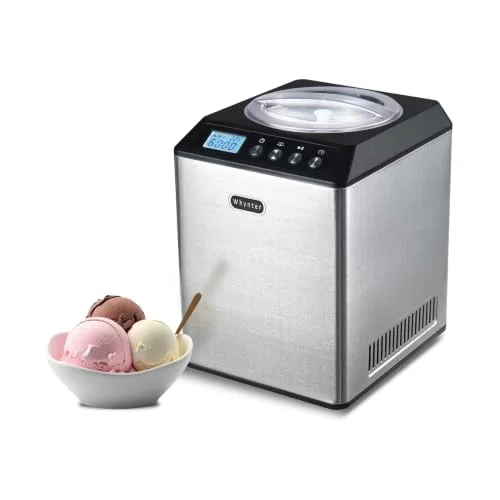
Whynter ICM-201SB Upright 2.1-Quart Compressor Ice Cream Maker

Best for ice cream on impulse, batch after batch

2.1 quarts·Built-in compressor·Upright stainless housing·LCD display and timer

Whynter builds this one upright, with a self-contained compressor and a 2.1-quart bowl in a stainless steel housing, and says the shape gives it a smaller counter footprint. Nothing waits in the freezer: the compressor freezes the mix as it churns, and a second batch can follow the first the same afternoon, which is the real reason to pay for a compressor. An LCD display and timer show where the batch stands. The listing leaves out weight, dimensions and batch time. Compressor machines are heavy by nature, so plan for this one to live on the counter.

Pay the premium if you make ice cream on impulse or by the batch; this one pairs a big bowl with an upright shape.

Whynter ICM-201SB upright compressor ice cream maker in stainless steel
Price
$207.84
Check price →
03Best Creami-style

Ninja CREAMi XL Deluxe Gen 2 (NC601)

Best for low-sugar, high-protein and dairy-free recipes

24-oz XL tubs·11 one-touch programs·Dairy-Free and CreamiFit·19.5 in tall

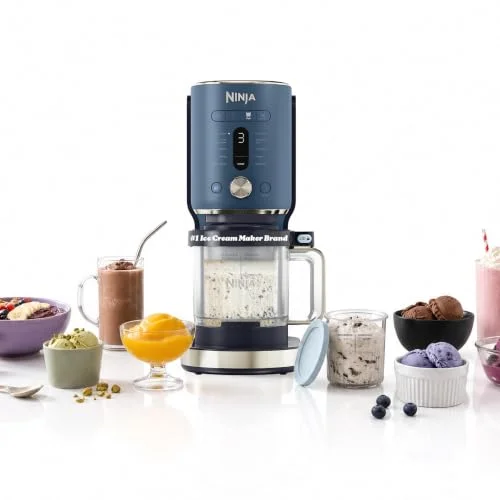
The CREAMi freezes nothing. You mix a base, freeze it solid in a tub, and the machine drives a spinning blade down through the block to shave it smooth. A churn needs sugar and fat to stay soft, while a frozen block can be shaved creamy from much leaner recipes — hence the Gen 2’s Dairy-Free, Smoothie Bowl and CreamiFit programs, three of its eleven. Each XL tub holds 24 ounces, 50 percent more than the original CREAMi pint. The costs: every tub must be frozen solid in advance, the listing does not say how many tubs are included, and the machine stands 19.5 inches tall.

Buy it for lean, high-protein or dairy-free recipes. For a classic custard base, a churn is simpler.

Ninja CREAMi XL Deluxe Gen 2 NC601 frozen-pint processor in navy
Price
$199.99
Check price →
04Best soft serve

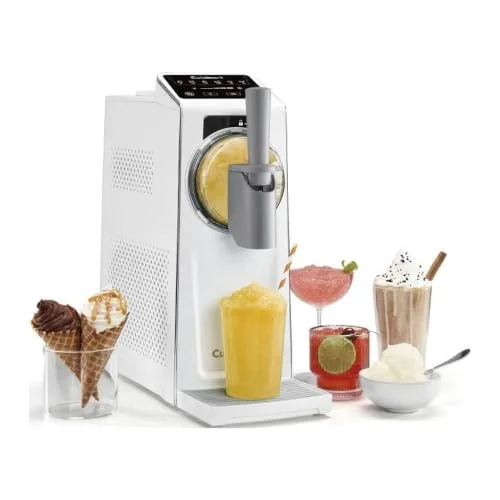
Cuisinart ICE-200 Soft-Serve and Slushy Maker

Best for soft serve and frozen drinks at parties

1.7 quarts·No pre-freezing·6 presets·Handle dispenser

A soft-serve dispenser rather than a churn you scoop from. Cuisinart’s Quick Freeze Chill Technology cools the 1.7-quart bowl itself and holds the mix at serving temperature, so nothing goes in the freezer ahead of time; Cuisinart quotes the first slushy in as little as 15 minutes. A handle pours straight into a cone, cup or glass, and Smart Dispense manages the speed and direction of the pour. Six presets run from soft-serve ice cream and sorbet to slushies, frappés and frozen cocktails. The limit is focus: four of the six presets are frozen drinks, and the listing describes no setting for firm, scoopable ice cream.

Buy it for the swirl and the party, not for a freezer full of scoopable pints.

Cuisinart ICE-200 soft-serve and slushy maker with dispensing handle in white
Price
$159.00
Check price →
05Best budget compressor

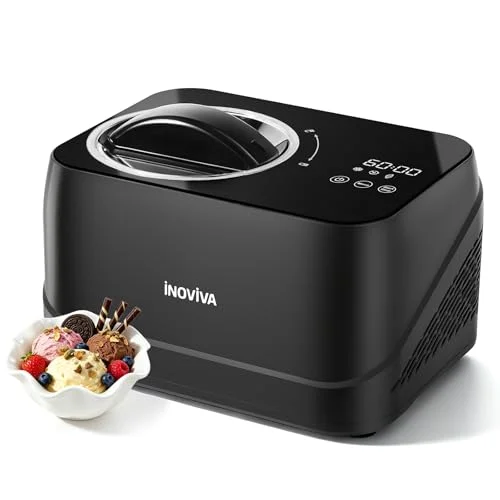
Inoviva IM001 1.7-Pint Compressor Ice Cream Maker

Best for a compressor machine on a tighter budget

1.7 pints·Built-in compressor·3 presets·About 60 min per batch

Compressor convenience in the budget tier. The built-in compressor means no bowl in the freezer and no planning: add the ingredients and, by Inoviva’s own estimate, wait about 60 minutes. A digital display and timer run the batch, there are three presets, and a continuous cooling function holds the texture once the ice cream is done, so it can wait if dinner runs long. At 1.7 pints, a batch is a little under a quart: dessert for a small household, not a party. The listing names only ice cream and gelato among its uses and publishes no wattage, dimensions or weight.

A sensible way to find out whether a compressor earns its counter space, if small batches suit you.

Inoviva IM001 compressor ice cream maker in black
Price
$109.99
Check price →
06Best single-serve

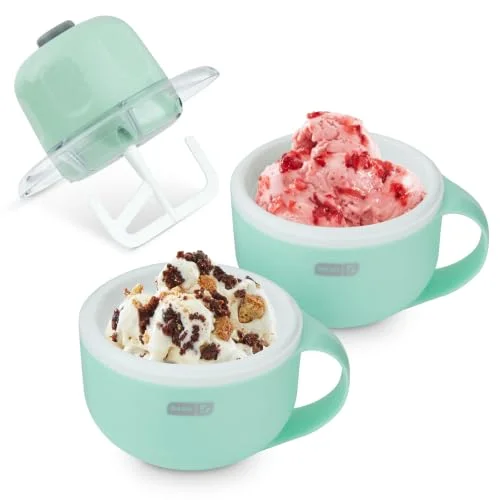
Dash My Mug Ice Cream Maker, Two-Pack

Best for one or two people

Half-pint mugs·Mugs freeze 24–48 hr·About 20 min·Ingredient chute

Dash shrinks the freezer-bowl idea to one serving: the frozen mug is the bowl, and you eat straight from it when the churning stops. Each half-pint mug needs 24 to 48 hours in the freezer, so Dash suggests keeping both frozen and one always ready. Churning takes about 20 minutes; the listing names ice cream, gelato, non-dairy nice cream, sorbet and frozen yogurt, and a built-in chute takes chips, sprinkles or fruit near the end. The limits come with the format: a half pint is one generous portion, and the listing does not make clear whether the two-pack includes one motor base or two.

Dessert for one, eaten from the bowl it was churned in.

Dash My Mug ice cream maker two-pack with aqua half-pint freezer mugs
Price
$44.99
Check price →
Our method

How we picked — and what we can’t tell you

What we did

Specs, prices and manufacturer data

We compared published specifications and current Amazon prices for 39 ice cream maker listings — just over thirty distinct models once color variants are folded together — across freezer-bowl churns, compressor machines, Creami-style processors and soft-serve dispensers. We weighted what each maker commits to in writing: how the machine gets cold, how far ahead it makes you plan, capacity against stated yield, and programs and paddles. We treated churn-time claims with suspicion, because twenty minutes means little next to a 24-hour freeze, and we flag gaps rather than fill them. Where a model comes in several colors at different prices, we link one; check the others before you buy.

What we didn’t

We don’t run a testing lab

We do not physically test these machines, we do not own them, and we do not publish invented scores out of ten. We also have no verified rating data for this category, so this site publishes no ratings of any kind — we would rather show nothing than make something up. The questions that matter most over the years — how a compressor holds up after a few hundred batches, whether a freezer bowl survives years of freezing and thawing, how a blade wears against frozen blocks — cannot be answered by anybody who has had a machine for a month. What we can do honestly is read every specification, compare them, and explain the mechanics behind them.

Go deeper

The guides behind the picks

FAQ

Common questions

Is a compressor ice cream maker worth it over a freezer bowl?

Only if planning is the problem. A freezer bowl makes the same kind of churned ice cream; what it cannot do is go from idea to dessert on the same evening, or make a second batch without a second frozen bowl. A compressor chills as it churns, so you can start whenever the base is cold and run batches back to back. The costs are price, counter space and weight. If you can freeze a bowl the day before, the freezer bowl is the better buy.

How long does a freezer bowl need to be in the freezer?

Cuisinart’s figure for its double-insulated bowls is about 24 hours; Dash quotes 24 to 48 hours for its My Mug. A quick check is to shake the bowl: if you hear liquid moving inside the walls, it is not ready. Keep the freezer at 0°F, the temperature the FDA recommends for home freezers, and store the bowl at the back, where it stays coldest. Chill the base in the refrigerator too; a warm base thaws the bowl before the ice cream sets.

How long does it really take to make ice cream at home?

Add up every clock, not just the churn. The churn runs about 20 to 25 minutes in a freezer-bowl machine, by Cuisinart, Elite Gourmet and Dash figures, and anywhere from 20 minutes to an hour in a compressor machine — Instant Pot quotes 20 minutes or less, Inoviva about 60. Before that, the base should be cold; Homtone recommends at least four hours in the refrigerator. A freezer bowl adds about a day. Afterwards, a few hours in the freezer firms the ice cream for scooping.

Is the Ninja CREAMi actually an ice cream maker?

It makes ice cream, but not the way a churn does. A CREAMi does no freezing: you freeze a base solid in its tub, and the machine shaves the block into a creamy texture — Ninja describes its Creamify technology as finely shaving through a uniformly frozen pint. Because the block is already hard, it copes with low-sugar, high-protein or dairy-free recipes that would churn up icy. The trade-offs are planning, since every tub is frozen in advance, and freezer space.

Why is my homemade ice cream icy or hard?

Usually one of three reasons. The base went in too warm, or the bowl was not fully frozen, so it churned slowly and grew large ice crystals. The recipe was low in sugar or fat, both of which keep ice cream soft at freezer temperature. Or it sat in the freezer for days: homemade ice cream lacks the stabilizers in most store-bought ice cream and hardens faster. Chill the base well, churn in a fully frozen bowl, and eat it within a few days.

Can an ice cream maker make frozen yogurt, sorbet and gelato?

Nearly every machine here lists frozen yogurt and sorbet, and most list gelato. The difference lies mostly in the recipe: sorbet has no dairy, frozen yogurt swaps much of the cream for yogurt, and gelato is usually richer in milk than cream and takes on less air. A few machines build that in: Cuisinart’s ICE-100 has a dedicated gelato paddle, and the ICE-70 runs separate ice cream, gelato and sorbet programs at different speeds.

Is it safe to use raw eggs in homemade ice cream?

Food-safety agencies advise against it. The standard published guidance from the FDA and USDA is to use pasteurized eggs or egg products, or to cook an egg custard base to 160°F, checked with a thermometer, then chill it thoroughly before churning. Philadelphia-style ice cream, made from cream, milk and sugar with no eggs, avoids the question entirely. This is general information, not medical advice; anyone pregnant, older or immunocompromised should follow their doctor’s guidance.